Monday Moth

  • Monday Moth

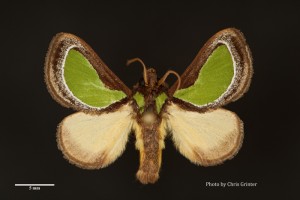
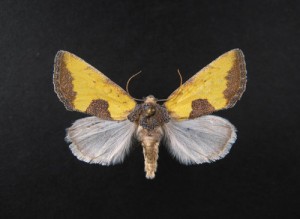
    Back to the Monday Moth!  This beautiful insect is Stiria dyari (Noctuidae) collected on a February trip outside of Cataviña, Baja California Mexico.  I believe the host plants are still unknown, but all of the moths in the genus Stiria have these brilliant yellow forewings that help camouflage them on the stem of a yellow…
  • Monday Moth

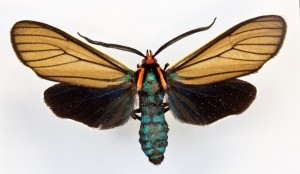
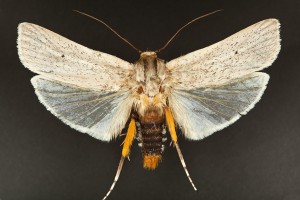
      Another huge Australian “microlep”, (probably) Maroga setiotricha: Xylorictidae – measuring in at 60mm.  With wings like this they must make formidable fliers. According to the Xyloryctinae Moths of Australia blog the larvae are stem borers into Acacia sp. (Mimosaceae).  This specimen was collected in November of 1962 by Ed Ross in Canoona, Queensland.

  • Monday Moth

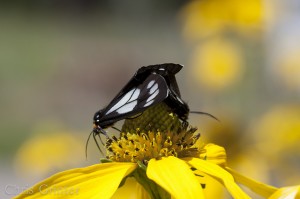
      This Monday moth is an Arctiinae, Gnophaela vermiculata.  These beautiful day flying moths were abundant on yellow Helianthus flowers around 9000′ in the Santa Fe National Forest, New Mexico.  Caterpillars feed on bluebells, but the adults prefer the highest quality nectar source in the area – which fortunately makes for easy and attractive photo subjects.

  • Monday Moth

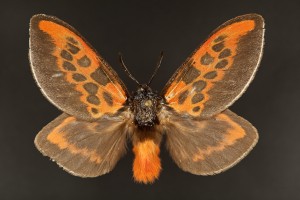
      This Monday moth is a stunning female of the Neotropical Megalopygidae – Trosia nigrorufa.  Ed Ross and Ev Schlinger collected this specimen in Peru in 1955, and I’ve heard many stories about these epic expeditions.  I can’t really imagine travelling via cargo ship, being gone for six or more months at a time and relying…

  • Monday Moth

    I’ll keep the ball rolling with Arctiinae and post a photo today of Ctenucha brunnea.  This moth can be common in tall grasses along beaches from San Francisco to LA – although in recent decades the numbers of this moth have been declining with habitat destruction and the invasion of beach grass  (Ammophila arenaria).  But anywhere…

  • Monday Moth

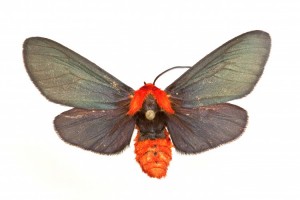
    Today’s moth is a beautiful and rare species from SE Arizona and Mexico: Lerina incarnata (Erebidae: Arctiinae).  Like many other day flying species it is brilliantly colored and quite likely aposematic.  After all, the host plant is a milkweed and the caterpillar is just as stunning (below).   This image of an old, spread specimen hardly…

  • Monday Moth

    I’m going to keep the ball rolling with this series and try to make it more regular.  I will also focus on highlighting a new species each week from the massive collections here at the California Academy of Sciences.  This should give me enough material for… at least a few hundred years. This week’s specimen…