Species

  • Monday Moth

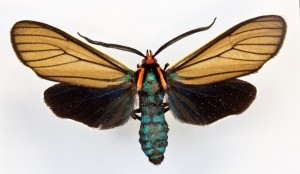
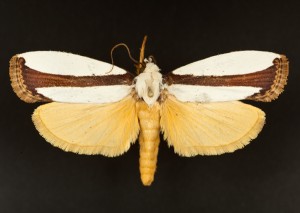
    ANSWER:  This wasn’t easy – but this large and beautiful moth was from Australia and is in the family Xyloryctidae (Philarista sp.).  We have a handful of representatives of this group here in the US and Ted MacRae over on Beetles in the Bush has a few great photographs of them.  Somehow I think we got the…
  • Monday Moth

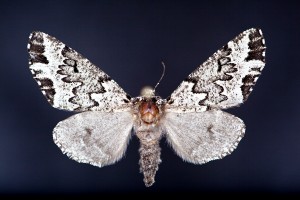
    This Monday’s moth is a spectacular species from the mountains of Arizona – Chiricahua multidentata, a Geometrid.  The only known location for this species is at the very top of the Chiricahua mountains above 9,000 feet (which was just bruned to a crisp).  Hopefully the fire was not entirely devastating and the population will rebound in the…

  • Monday Moth

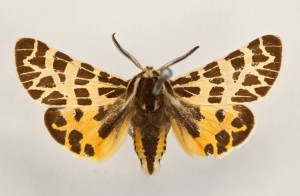
    I’ll keep the ball rolling with Arctiinae and post a photo today of Ctenucha brunnea.  This moth can be common in tall grasses along beaches from San Francisco to LA – although in recent decades the numbers of this moth have been declining with habitat destruction and the invasion of beach grass  (Ammophila arenaria).  But anywhere…

  • Monday Moth

    I’m going to keep the ball rolling with this series and try to make it more regular.  I will also focus on highlighting a new species each week from the massive collections here at the California Academy of Sciences.  This should give me enough material for… at least a few hundred years. This week’s specimen…

  • Mystery Revelaed

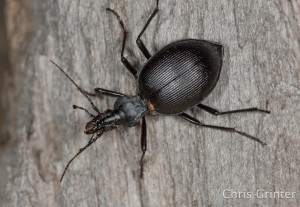
    OK – a few apologies for not having full images *yet* of the larvae in question (I will in a few days!).  Over the weekend I was out with a group of Berkeley students on Mount Hamilton and PhD candidate Meghan Culpepper collected a few species of Scaphinotus and a some larvae!  So the specimen…

  • |

    Estimates of Global Species Diversity

    This recent article in the American Naturalist has taken a second look at some of the famously inflated species estimates, some going high as 100 million (Erwin, 1988).  Estimates conducted by the authors indicate that projections above 30 million have probabilities of <0.00001.  Their estimated range is more likely to be between 2.5 and 3.7 million…

  • Aquamoth part 2

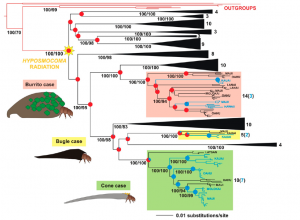
    I came across the full-text PDF of the amphibious moth article and extracted the tree showing the radiation of this species group and probable evolution of the amphibious traits.  Interesting to note the case shape, and each moth is endemic to its own volcano in the Hawaiian archipelago. This is a Bayesian analysis of a…

  • Aquamoth!

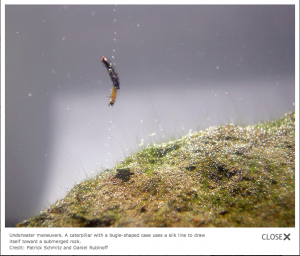
    Another amazing animal from Hawaii – a completely amphibious caterpillar (published in the March 22 PNAS).  While there are a few aquatic Lepidoptera, all of them have gills that keep them restricted to the water (mind you, we are talking only about the larval stage).  If their stream dries up, so does the caterpillar.  The…